
Who Is Like Us?
Probably more people than you think...Thoughts on national pride and folk music.


The D’Hondt System
You know how it is. Sometimes a series of events in the real world just interlocks with stuff that happens to be happening in your thoughts anyway, such that everything seems to form a matrix of neatly interconnecting ideas and events. We’ve all been there. As you might know from previous PiC’s (my new, I feel quite chummy, acronym for ‘Pete in Copenhagen’) we have had parliamentary elections in Denmark. The results of these are, at the moment of writing, three days after the event, still inconclusive, which is not atypical for the proportional electoral system in this country. In brief, a parliament of 179 seats or ‘mandates’ is elected, containing representatives of twelve political parties. These politicians are given mandates in the house in proportion to the number of people who voted for their parties, apparently according to a specific algorithm with the delightfully Mad Magazine-esque title of the ‘D’Hondt System’, to whose mathematical complexity my comprehension is forced, with no large reluctance, to concede defeat. To have an overall majority in the parliament requires 90 votes, a feat which no single party has achieved in modern times, and so post-election wheeling and dealing can go on for weeks before a working coalition emerges. It’s actually quite a sensible system, I think, but as drama it’s a bit lacking in cogent narrative drive. Right now we’re shaping up for a centre-left ish coalition….or a centre-right ish coalition depending on who you ask. The key player in all of this is Lars Løkke Rasmussen and his ‘Moderate’ party who hold 14 seats in the centre-right-ish and consequently the balance of power.
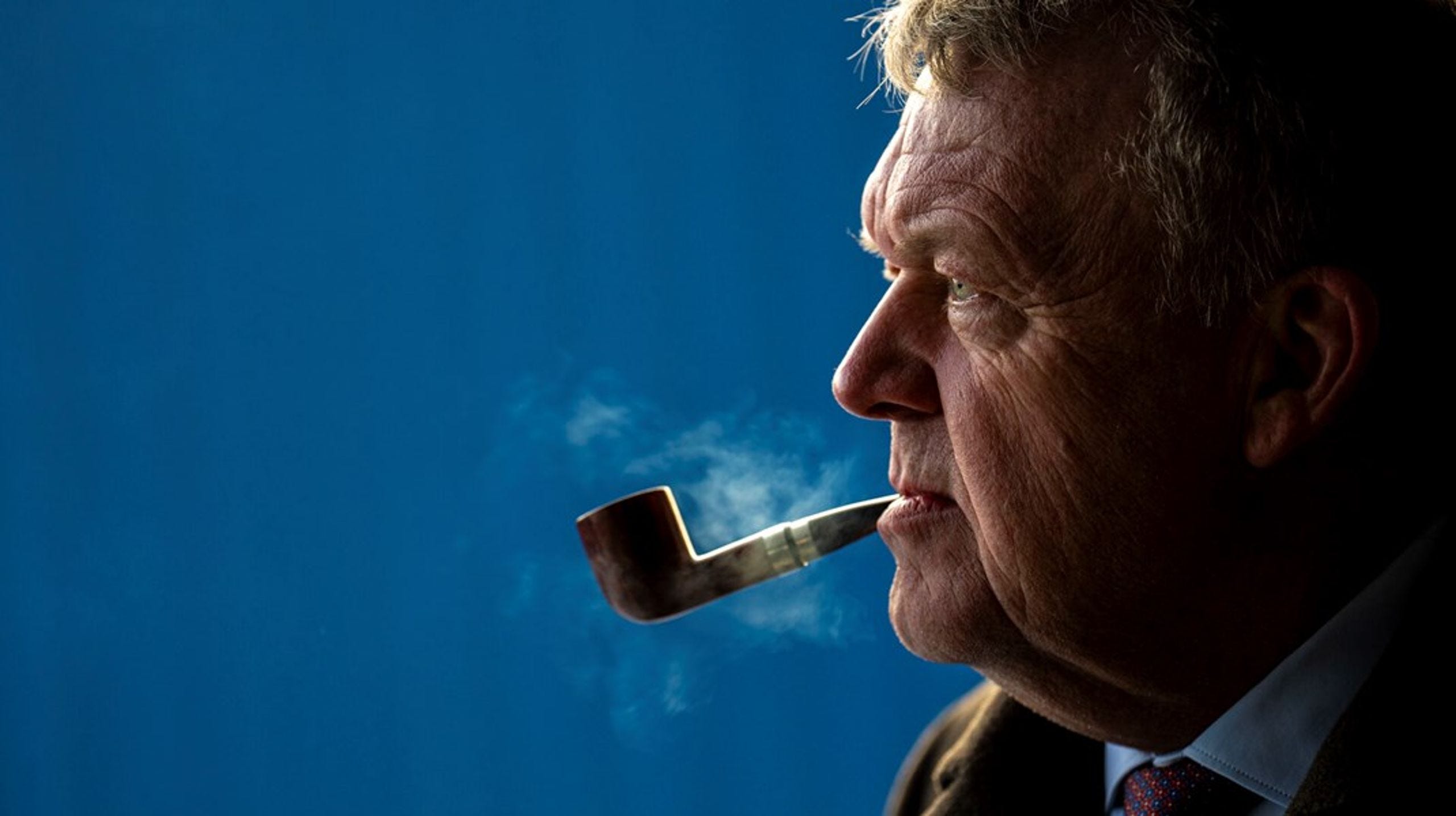
Lars Løkke is himself a former PM and is Denmarks current Foreign Secretary. You might recall him from the recent TV footage of his blinking emergence into daylight in Washington after a fraught negotiation session with the USA about Greenland, in which he’s seen in a huddle with the Greenlandic representative, desperately fumbling for his cigarettes, lighting up and hungrily, though somehow slightly furtively drawing on a gasper as though having just narrowly survived a charge across no-mans-land at Passchendaele. Indeed the act of smoking tobacco has become so much of a brand for Lars Løkke, a bit avuncular, a bit ‘of the people’, that he’s decided to play along, and is now rarely seen without a pipe sticking out of his mouth like a rounder Monsieur Hulot. At any rate there seems to have been a welcome consensus that we need to marginalize those whom I’ve previously referred to as Weird-Racist-OK-Lets-Face-It-Actual-Fascist-ey factions (WROLFIAFs). The most pernicious of these would be DF, Dansk Folkeparti, or ‘The Danish Peoples Party’ - In my experience one should always be wary of a party with the word ‘People’s’ in it’s name. The DF and two other racist anti-immigration parties look to have been left seething on the sidelines, despite having scooped up 17% of the votes between them, which doesn’t seem like much until you realize that the largest party, the Social Democrats got about 22%. This begs the question of why so many Danes wish to go down this road, and led me to think about nationalism, national pride and …somewhat perversely, but bear with me…. folk music.
People from Staffin ‘mental’…
As a Scottish person abroad I often find myself in a rather thorny position when discussion turns to questions of nationalism and national pride. I’m quite ‘proud’ of being Scottish, and I suspect this has something to do with the impression, perhaps self-delusional, that people out in the world generally like us as a bunch, and find us quite congenial to be around, like labradors or alpacas. In my darkest hours, though, I do wonder if that has become something of a self-perpetuating stereotype attributable to the specific charisma of a few particular people, your Billy Connollys, Ewan MacGregors, Sean Connerys and… OK maybe a few others but if you’re being honest mainly those three. In other words my ‘pride’ may be a kind of stolen valour, a reflected quick-witted, couthy, twinkly-eyed-in-your-cups glory in which it’s easy to bask, but which is ultimately based on the good solid work which has been put in by other more admirable, better qualified candidates. Equally I believe that, should the Turkmenistani equivalent of Ewan Macgregor emerge and hit the big time internationally, then there’s no reason why people’s faces won’t also light up a bit if you say you come from Ashgabat. I’m also, for a whole ream of reasons, a Scottish Nationalist, in the purely political sense that I believe Scotland should have independence. This can sometimes trigger people from outside the UK who may have the same feelings, often understandably depending on their background, about anything containing the word ‘Nationalist’ as I do about ‘Peoples Parties’. However I see modern Scottish Nationalism as something very specific, a left-leaning social democratic position mostly predicated on its opposition to exactly the kind of brutish British nationalism to which it’s sometimes erroneously and often perniciously presented as being equivalent.
Logically speaking of course, it makes no more sense to be ‘proud’ of the country one is ‘from’ than it does to be proud of any other geographic attribute which you may possess, like if you happen to live in close proximity to, say Stonehenge, or the Mariana Trench, or the M25 motorway. People also sometimes display an odd, unpredictable and unsystematic specificity with regard to this. Whilst you rarely hear someone speaking of their ‘pride’ in coming from the northern hemisphere, they may nevertheless be oddly proud of being European, or at least of being West European. They may be ‘proud’ of being English but have no strong feelings about the fact that they ‘come from’ Buckinghamshire. Others may be ‘proud’ of being from Edinburgh but may also be British Unionists and therefore actively scornful of the whole idea of Scottish Nationalism or even ‘Scottishness’ at all. It’s all a set of judgements alarmingly lacking in any kind of rigour or consistency. Nevertheless this kind of thing can reach levels of absurd, jaw-dropping specificity. I once knew a guy who both came from, and lived all of his life in Portree, the largest, indeed the only, town on the Isle of Skye in Scotland. He would often be heard to voice his belief in the theory that forming close personal relationships with any individuals from the picturesque coastal village of Staffin, some 17 miles further north, was, objectively speaking, well nigh impossible as they were genetically predisposed to being, as he put it, ‘mental’. This is of course patently silly, but really only in a question of degree. In essence it’s little different from what one can hear from the English about the French, from Jutland people about Copenhageners, from Americans about pretty much everybody else, and from pretty much everybody else about Americans.
I suspect that all of these judgements and chauvinisms have a few basic tenets to which they hold, and which define their boundaries. Let’s, for the sake of argument make up a random geographical chauvinism based on a pride in coming from, say, Clackmannanshire. It probably goes like this.
There is some indefinable personal quality possessed by people like us from Clackmannanshire which indisputably sets us apart from others.
The possession of this quality by people of Clackmannanshire is somehow causally connected to their being from Clackmannanshire.
This quality is recognized by we who come from Clackmannanshire, and may also be recognized and admired by outsiders.
If outsiders don’t recognize this quality it is because, not being from Clackmannanshire themselves, they lack the ability to perceive this quality and therefore don’t ‘get’ us
If outsiders happen to recognize this quality, but don’t admire it, then they damn well should.
If outsiders happen to recognize this quality, but don’t admire it, then it also may be because they are simply envious of those, like us, who possess it, being, as we are from…..
And so on and so on….
I maintain that this template would apply on both micro- and macro- levels of all kinds of nationalism, both at the mild and barmy ends of the scale.
A Packet of Rennies
But folk music…Although I don’t do it much anymore, I have spent a good deal of my adulthood playing, singing and listening to British and Irish folk music. It’s an art form which is extremely dear to my heart and has provided me with the kinds of musical epiphanies which music lovers most often associate with other genres such as classical music, jazz or what 70’s BBC DJ’s used to call ‘pop and rock’. The music literature is awash, almost to the point of banality, with people whose artistic lives were altered forever the first time they heard Jimi Hendrix, Elvis Presley, Miles Davis, Schoenberg or whatever. I, too have felt the same way about similar artists and can fondly remember the strange, unique cocktail of emotions common to that first-time experience; a kind of skin-tingling and an oddly fearful sense that a door has just opened that you never realized was there, and that to enter it changes stuff for good.
(By the way, if you’re a person for whom music doesn’t do much, then believe me, I can see that this must seem like the biggest load of overblown tosh…it’s only music after all… I feel the same way about…I don’t know…cricket…)
But for me, my epiphany list of ‘first time I heards’ that blew me away would, for example, include Scottish singer Dick Gaughan singing ‘Willie O’ the Winsbury’ – you don’t usually associate an accent like his and ours with music and storytelling as lyrical and beautiful as this. Granted, the 1970’s album cover from which this track is taken is a dreadful photo of Dick looking like he’s been sleeping in a tent on an Aberdeenshire camp site in April, has slept in his clothes, his pants are a bit up his bum crack, and he’s popped down to the chemists at the harbour early in the morning for a packet of Rennies.
My list might also include lying in bed late at night in my parents house in the late 70’s and listening to June Tabor singing, all alone ‘The Band Played Waltzing Matilda’ in session on the John Peel show on BBC radio 1
Both of these are, I think, iconic performances, one Scottish one English (though written by Eric Bogle, a Scot) which can and do stand up as pieces of music in any context. However I’d be lying if I said that their appeal to me had nothing to do with a sense that this music is somehow part of a British culture with which I feel I have some connection. We share a language, for one thing, and certain modes of formulation, ways of articulating thoughts and a kind of decorum about how things should be told. Also, the specific cadences and modes of this music and this kind of song have been embedded in our culture in many versions over time - childrens songs, the music associated with seasonal festivals, even the songs that your auntie would sing after a couple of Babychams at NewYear. In this particular case I can see how a sense of geographical commonality can induce feelings of…not quite 'pride’, more a form of solidarity or shared experience.
Interestingly, I think that other folk musics from other places can also have this magical effect at a distance, as it were, despite the lack of any kind of geographical solidarity. A great example is American blues, which somehow managed to speak to people in post war 50’s and 60’s UK and Ireland in a way which it wasn’t even particularly doing to Americans at the time. And so we have the pleasingly odd phenomena of Irish people who are ‘proud’ of both Rory Gallagher’s Irishness and his prowess as an iconic, and somehow ‘authentic’blues guitarist, or Scots who adore Frankie Miller as one of the great ‘soul’ voices, his Glaswegianness somehow part of what moves you, despite the fact that there’s almost no Scottishness in his singing accent. The other example I love is Finnish Tango, a wonderful, extensive and very popular genre in Finland which somehow sees and articulates in musical form a solidarity between something of the melodic patterns of Slavic/Russian music, songs sung in Finnish and the halting glide of Argentinian Tango and then makes it something that Finnish people can be proud of. Just…why…how?
This ‘solidarity’, a word which we tend to use more sparingly in these times for fear of being mocked as leftist anachronisms is, I think, the foundation of what I venture to suggest might help to define a ‘healthier’ nationalism, one which has more to do with a common cultural chiming than an exclusive sense of being special. In essence, if you’re going to play a national pride card then you’d better be damn sure that you know what it is in your culture you’re proud of, and not just what you’re defending it against. Your skin colour or your random location on the map ain’t enough.
Mind you, that does require us as Scots to adopt an ironic distance when spouting the tired cliché when we raise the toast ‘Here’s tae us. Wha’s like us? Damn few and they’re a’ deid’.
Or in standard English, ‘Here’s to us. Who is like us? Damn few and they’re all dead’