

Firstly, to arrive at the assertion that episodes in life can resemble episodes of a situation-comedy requires a journey more fraught with complexity than one would imagine. First of all, on thinking about it more closely, the very notion of ‘sit-coms’ feels somewhat of an anachronism – do they really, actually exist any more? I mean proper ones with all the tropes and features: a theme tune you can sing to your mates in the canteen, a cast of recurring, predictable characters, at least one of whom you think you can impersonate and another of whom you probably fancy a bit, an episode length of max 30 minutes and no baffling twists of any consequence in any over-arching narratives, in fact preferably no over-arching narratives at all, meaning you can drop in almost anywhere and still sort of know what’s going on. Well do they? First, let me tell you a tale…
Replete With Timpani
Last Saturday, at the conclusion of being on tour in Denmark, the details of which I’ve mentioned in ‘Pete in Copenhagen’s passim, I found myself temporarily resident in a large chain hotel in the city of Århus in Jutland for a few days and nights. A pleasant place and a fine example of its kind. On the second day, one of our team, the person who had made the booking, received an email message from the management conveying the following - and I translate here directly from Danish…
…I hope that those who arrived yesterday have settled in well at the hotel. I am writing because on Friday evening and Saturday morning we have a Brass Band practicing in a meeting room, and unfortunately it is exactly below the rooms that your guests from yesterday checked in to. There is a risk that it will be noisy in the rooms above, and we would therefore like to avoid having any people staying here. It is of course unfortunate that we were not aware of this yesterday when you checked in. The band practices Friday afternoon, again in the evening until 11:00 p.m., and again on Saturday from 9-12:00 a.m.
Now you may or may not see my point if I tell you that any irritation I felt at what is ostensibly a minor, though potentially inconvenient screw-up is offset by the sheer, joyously gratifying ‘Fawlty Towers’-ness at play here. In particular, I feel that there is a simple beauty in the way that the overall tone of the hotel’s communication, while level, is nevertheless barely concealing tantalising hints of Basil-style panic behind the scenes. Let’s take a closer look. A number of elements leap to the fore immediately.
I have no idea why, but Brass Band inexplicably written in English, and also capitalised in the original email I found (and still find) very funny.
It should go without saying that the phrase ‘unfortunately…exactly below the rooms’ should be accompanied by whatever punctuation mark or emoji one uses to denote John Cleese rolling his eyes – if one does not exist then it should.
‘It is of course unfortunate that we were not aware of this yesterday when you checked in…’ ….I mean you can practically play out the scene in your head. Manuel has been asked to cover at reception while Basil is off on some hapless errand in Torquay unbeknownst to Sybil1. The Brass Band-leader, in full band uniform, possibly with gold braiding on a peaked cap and carrying a mace, pulls up to reception to explain the booking and a mayhem of cross-purposes, misunderstanding and incomprehension ensues.
In addition, I feel sure that the line ‘…we would therefore like to avoid having any people staying here’ must surely have actually been used by Basil Fawlty in at least one episode.
and…the specificity of the times at which the band, sorry, ‘Band’, were to rehearse, surely chosen to maximise the extent of irritation they are likely to cause to residents, would have evoked a hissed ‘What!!??…*
POLLY: There is a risk that it will be noisy…’
BASIL: ‘Oh, I see…merely a ‘risk’… naught but a ‘risk’…Oh well that’s a relief …that’s all right then isn’t it?…why worry…of COURSE IT’LL BE NOISY!!!’ THEY’RE A BLEEDIN’ OOMPAH BAND!!!’
I feel that the tragedy of this particular sit-com episode/real-life interface – and there was always a darkness lurking beneath the Fawlty family – is encapsulated by the fact that the hotel, to its credit, felt moved to even reveal so much information about this cock-up in advance instead of choosing to field any complaints as they arrived. This suggests a rapid progression through familiar stages of grief after processing the dawning horror of discovering the booking, arriving possibly prematurely at ‘resignation’.
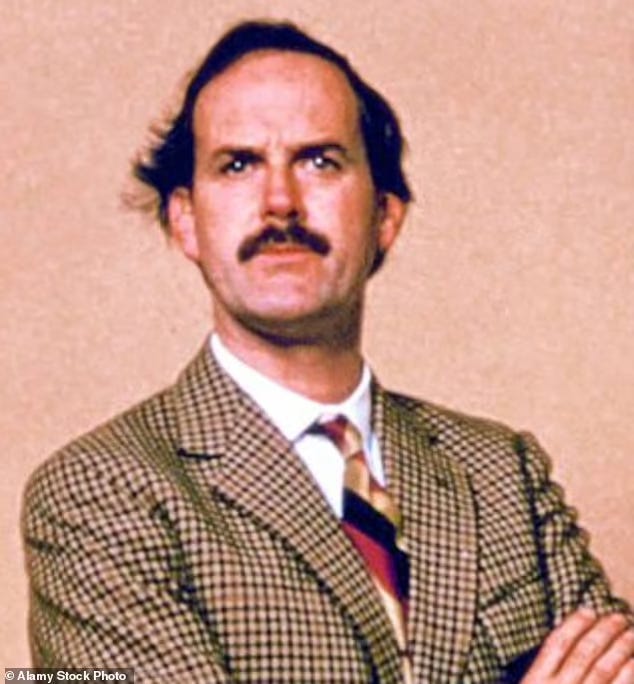
We were offered other rooms on another floor but opted to stay put while the Band, who sounded actually and impressively more like a proper Orchestra, replete with timpani and booming bass drum, did their stuff into the night and then again early in the morning. The Major would surely have been baffled. In conclusion I feel that the theme tune on the playout of this episode would of course have been played by a creaky Brass Band rather than the customary string ensemble.
Pure Marie Lloyd
Here’s my point though. It’s not simply that real life imitates art, but that the art being circumstantially imitated sometimes seems to me to be so genre-based and specific that I wonder if the likeness would be lost on those who did not grow up with a familiarity with that genre. I feel sure that there must be thirty-year-olds walking around going ‘this is so OITNB!’2 in situations to which I’m utterly oblivious. It’s also interesting to reflect that historically this phenomenon is dependent on (a) there being any popular art at all, and (b) on there being art of which enough people have a common experience to the extent of them recognising it in real life. Are we now so saturated with popular culture that we cannot imagine existing in a real world in which we don’t recognise anything as being a bit like what we’ve seen in a film, series or TV-programme?3 Did music-hall-going Londoners in the early 1900’s walk around going ‘I was in the bakers yesterday and it was pure Marie Lloyd’? Can we conceive of a culture in which nothing at all can be post-modernistically referred to? What the hell would people have to talk about…their actual lives?
Entanglements of Intermediality
Perhaps more beyond question is the converse notion that the recurring tropes and patterns we see in comedy reflect the concerns and enthusiasms of the society that surrounds us. If we stick with the old-fashioned description of situation comedy that I proposed at the start, then by virtue of its very popularity and ubiquity this genre of comedy has surely in the past been more of a mirror-held-up-to-society than any others. However, I’d suggest that nowadays that role has been usurped by video recordings, the Netflix and HBO specials, of stand-up comedians. These have almost supplanted televised political debates to become the actual forum in which people who think actual thoughts discuss socio-politics.
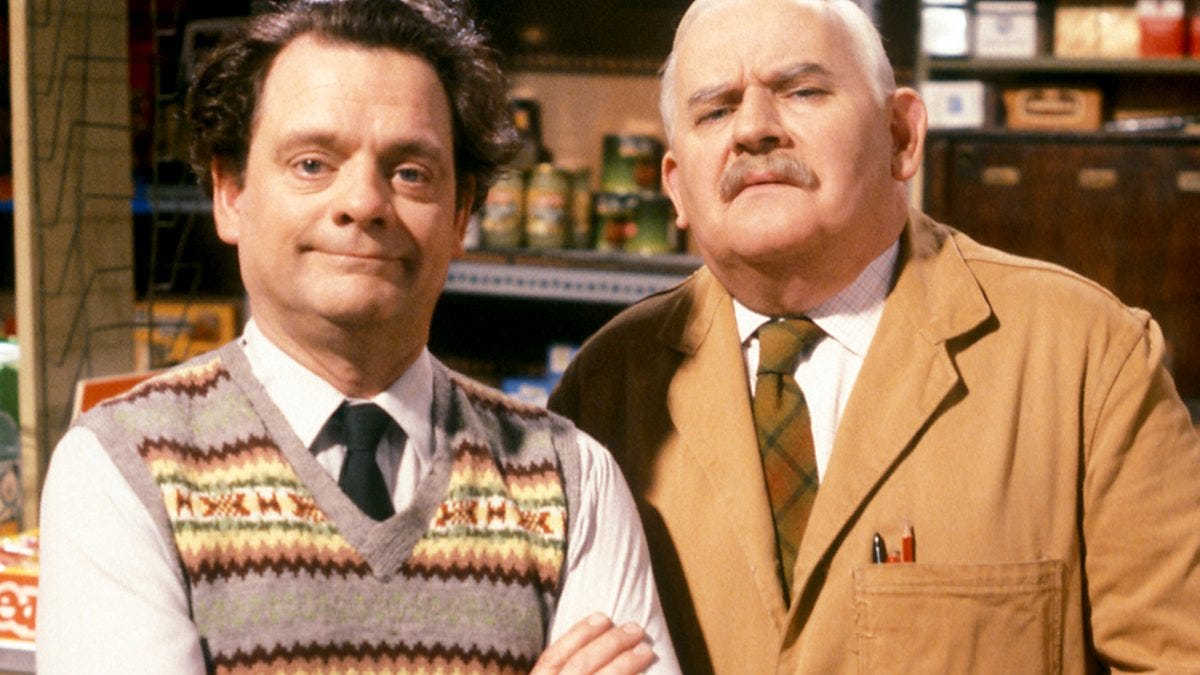
Together with my friend Steve –who I’m realising is himself rapidly becoming a recurrent character on these pages – I was having a pub conversation, as you do, about old sit-coms we remembered, me from the 70’s and he from a bit later. It struck us how many of them involve a single character, often male, who is portrayed as being trapped in a vaguely toxic relationship with another character, often a family member, whereby they are somehow infantilised, are eternally frustrated and long to break free, but never quite manage to do so. Think Harold in Steptoe and Son4, Rodney in Only Fools and Horses, Granville in Open All Hours, Ronnie Corbett in Sorry, Basil Fawlty of course… at a push you might add Joey in Friends, Dougal in Father Ted….if you think of more then let me know. What’s going on here? Does this reflect a kind of collective 70’s-80’s anti-authoritarianism, a sense, especially among the young, that there were freedoms being denied you by those in power? This ‘situation’ is also of course underpinned by a kind of tragedy, which some of the examples I mentioned have tapped into more than occasionally. I remember once watching the pilot episode of Steptoe, entitled The Offer , a piece of drama which would bring a tear to glass eye. You’d think, and rightly so, that old Samuel Beckett, with his eye for such tragi-comic grey zones, and love of trapping people in worlds from which they can’t escape, probably approved. Indeed I’ve subsequently discovered that there’s a whole fascinating literature of academic articles online which specifically point out these alignments and often deal specifically with the Steptoe-Beckett connection; looking forward to diving into that, especially the wonderfully titled Entanglements of intermediality: Polanski, Pinter, Steptoe and Son from Reading University. I promise I didn’t make that up.
What is perhaps even more striking is that neither Steve or myself could think of any sit-coms depicting women in analogous situations. Could this perhaps be because an equivalent infantilising of women has become so normalised that it wouldn’t be perceived as being ridiculous enough to have comic potential? Or maybe we’re just too squeamish about placing women in these kinds of slightly demeaning scenarios for comic effect. It’s certainly interesting, if faintly uncomfortable, to imagine Open All Hours with a female Granville. Would it be more or less weird if Ronnie Barker’s shopkeeper was a single woman together with her niece, rather than a man with his nephew? And would it, could it, be as funny, or is the premise too, I don’t know… wistful?
But I’d say that even today modern life can still feel like…at least like an episode of a ‘comedy’… to some of us. For this not to be the case would require a trope-free, cliché-free version of popular culture, a state of affairs I feel that we are approaching but at which we have not yet arrived. But I ask you, does anyone ever say: ‘Really? That’s so Bojack Horseman!’
Prunella Scales RIP, although people are saying she should have been better appreciated for some of her other stuff. She was apparently a brilliant theatre performer.
Orange Is The New Black, although I confess I’ve never heard anyone actually use this acronym
I still use ‘TV-programme’, not the Americanized ‘TV show’, as in ‘Question Time? I loved that show!’
I have an old colleague called Andy with whom I worked in a theatre group in Scotland serving adults with ‘special needs’ as they were described in the 80’s. He once told me that, as part of a drama workshop with this group he was helping a guy called David compile a kind of storyboard from various newspaper cuttings, among which was the familiar wedding portrait of Prince Charles and Lady Diana. The conversation went:
ANDY : (pointing to the photo) D’you know who this is?
DAVID: No
ANDY: Are you sure? Go on…take a guess…You’ve probably seen them on TV loads of times…have a think.
(….long pause…. )
DAVID: Steptoe and Son?…

Frank Spencer's poor long-suffering wife/The Liver Birds/ Yootha Joyce in the Ropers - whatever that was called/ Sharon & Tracey... maybe?
Enjoyed your piece - and Steptoe was top-level
Abso brilliant Pete!