

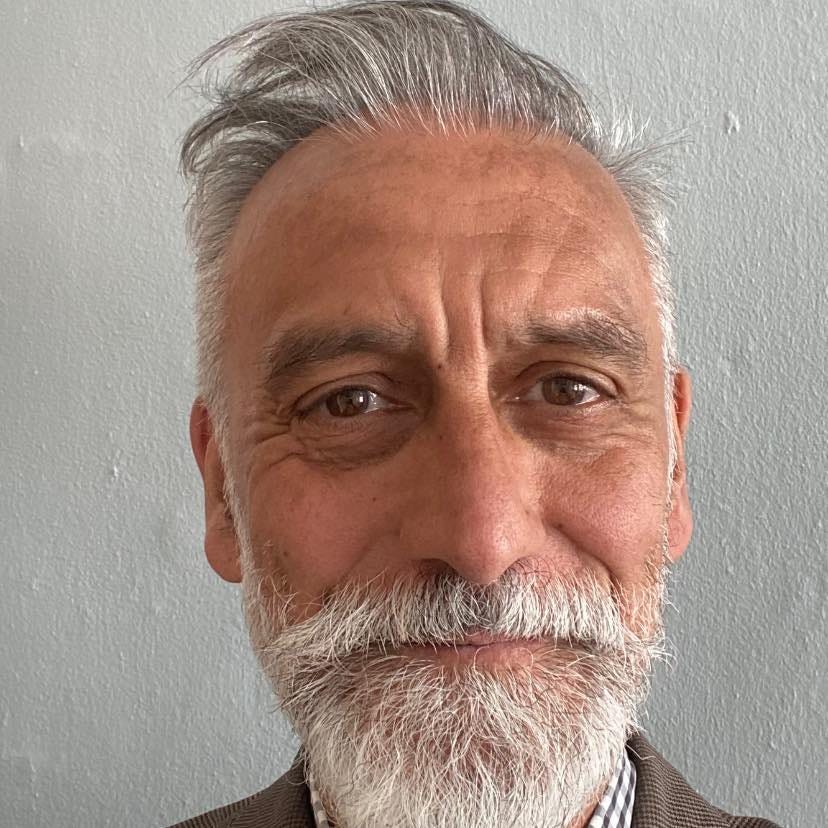
And so we find ourselves a year on from where we started. That’s to say exactly a year since I started this…what exactly? I would hesitate to refer to it as a ‘blog’. A blog seems more like a regular, somewhat methodical, journal, which aims to document events taking place in ones life. That was certainly a motive at the start, with my Diary of a Man With a Neck. This was my account of my experiences of throat cancer, which I wrote in a period of shall we say, corporeal uncertainty. By this I mean that, while I reckoned I was probably not necessarily going to die, I was nevertheless unsure, and not a little concerned as to how closely I would come to resemble an Otto Dix portrait of a trench-warfare survivor at the end of the whole palaver. Writing became something fun, and often actually funny, on which I could focus instead.But now I feel that this is more random than that, and less tied to the specificity of my daily narrative, eventful and fascinating though that may be to everyone. Put simply, I enjoy telling things, and this ‘platform’ (loathe that terminology) gives me the opportunity to tell about what I feel like telling. That said, I feel that this little anniversary day, a warm Copenhagen afternoon which finds me on my way to Glasgow for a few days, might be a good moment to get a bit real-life on you, and indulge in a spot of what Danes-like to call 'opsummering or ‘up-summing’.
And, Indeed, Genitalia
I’m still alive, it would seem. This is less of a mean feat than you might think. As I mentioned in Pete in Copenhagen in the past I have been, in my time, diagnosed with two, count ‘em two, entirely unrelated types of cancer.
The First; In 2022 I had, or ‘underwent’ as people often like to say, an operation, a ‘radical’ operation, no less, for prostate cancer. This involved a procedure carried out almost entirely by an amazing robotic device called ‘Da Vinci’. After the whole thing was over, my wife Nina managed to wheedle some information, in retrospect of a somewhat unsettling nature, out of the young surgeon who led the operation, namely that it was his first time doing this. He assured us that the professor had been looking over his shoulder the whole time. As Flying Ace Biggles might have said, I should blooming co-co. What’s even more disquieting, although in its way rather fascinating, about this is that the actual cutting, prodding, sewing and so on is apparently carried out by surgeons who are gathered round a screen at the other end of the operating theatre from where you are actually laid out, as though watching a particularly grisly war film. As far as I understand, they never actually touch you. Gone is the whole imaginary Doctor Kildare scenario, with medical personnel gathered in hushed reverence around a little spotlit area of your prone body and tersely requesting various utensils. No, this job is carried out via six proboscis-like appendages, plus a camera, all of which are poked through your skin and are operated remotely. As a result, my abdomen still looks like I’ve once been stabbed, albeit ever so carefully, six times in a knife fight, a scenario which seems much more ‘street’ than the reality, which is that I (a) now have to be careful lifting things in case I piss myself a wee bit and (b) will never ever again be capable of leaving a wet patch on a bedsheet. Incidentally I recently read of a group of British surgeons who took the ‘remoteness’ of this procedure to its logical conclusion and operated on some guy lying in a hospital in London while they themselves were sitting around a screen in Gibraltar. One hopes that they didn’t take advantage of their lack of physical presence on the job by secretly chugging on Aperol spritzers between scalpel strokes. My core memory of my own procedure consists mainly of the weird, opiate-induced euphoria I experienced in it’s immediate aftermath. I was so overjoyed at not feeling completely shit and at having most of the pain medicated away that I lay in my hospital bed and watched six straight episodes of ‘Friends’ on the little TV in my room, finding them atypically and uproariously hilarious. When my family came to visit, I horrified them all by talking non-stop about how great I felt and then cheerfully whipped back the bed covers to show them my new scars, oblivious to the horrific David-Cronenberg-like array of tubes, catheters, staples and indeed genitalia that this also entailed. In the words of Eric Bogle’s ‘The Band Played Waltzing Matilda’ ….they turned all their faces away.
Everything Still Kind of Works
The Second; One of the spooky things about the treatment I received almost 18 months later for throat cancer is that you don’t really know in what state you’re going to end up until at least about a year or so after the procedure. In my case right now we’re looking at 22 months since I completed particle therapy in Århus and I can’t complain. Everything still kind of works. I can still taste, spit, swallow, speak, sing and pronounce the word ‘ululation’ without too many problems. The only lasting effect seems to be a slight thickening of the saliva at the back of my throat which sometimes forces me to hack and spit alarmingly like an ex colliery worker who is not long for this world. Given the potential hazards of all forms of treatment for this condition, I feel that I’ve continued to get off lightly. In August, I’ll receive my last 6-monthly check, after which I’ll be called in once a year until 5 years have passed, on which date the Danish Health Service will officially lose interest in me. I’m already beginning to get a foretaste of how that might feel. The last check I had, in March, was carried out by a young female doctor who saw me alone, without any other consultants or staff present, which would normally be the case. After the standard ultrasound of the lymph nodes in my neck, and a fibre-optic peek down my throat, she hesitated somewhat and reached into a drawer, pulling out a device which looked like a set of swimming goggles with wires sticking out of them. After peering at these quizzically, she turned them around in her hands to examine them from various angles. She tentatively raised them to her eyes, took them away again, looked at them quizzically again and then said, like some character in Smack The Pony “I’m sorry, I’ve no idea how to use this thing…Anyway that’s you done, Peter, you’re fine” and returned the device to the drawer. I’m none the wiser.
A Small Audience of Kids
And so to Glasgow. I’ve written often about Glasgow here, as though I’ve spent much of my life in the city. The reality is that I only lived there while I studied for 6 years: I studied medicine for 2 years, failed at that, and then took a 4-year science degree. All in, I lived there from 1979 to 1984 and mostly hung out in the West End. At that time, in my head there was a kind of enclave which was defined by Partick Cross, Maryhill Road, Charing Cross and Hyndland, beyond which we student-ey types felt we would not be welcome. In contrast to this and visiting the city now, I’m struck by the omnipresence of students all across town. I even saw some wandering about in the East End, which in my day would have felt like the equivalent of popping into Phnom Penh as the Khmer Rouge were arriving. Indeed one of the sore points in Glasgow these days seems to be that older buildings are being torn down all over the city and replaced with ‘student accommodation’. This might on the surface sound kind of fun, a way to turn a neighbourhood into something a bit boho. In reality it’s often about developers hastily chucking up buildings in order to make a quick buck out of a seemingly expanding population of people who want to study in one of Scotland’s great university towns. Glasgow Uni was always notable for having a student population which was unusually local in origin, with a large percentage who lived at home, often with their parents. We who chose to ‘move out’ into often quite sordid private accommodation could often be rather sniffy about these home dwellers, regarding ourselves as being somehow more like the real thing. Nowadays I suspect that, with rents being the way they are, the option of students moving out into any accommodation whatsoever, no matter how sordid, has become more prohibitively expensive and less realistically available to people from low income families. And yet these new ‘student apartments’ keep springing up. An increase in student accommodation might at any rate explain why the entire city centre of Glasgow, no matter where I walked, seemed to smell sharply of what I suspect was particularly potent cannabis smoke, yet with no obvious reefer-enjoyers in sight. At one point, while strolling down Buchanan Street, passively inhaling what felt like the contents of a well-stocked bong, I passed a group of three policeman, apparently completely oblivious to the reek, standing, arms folded and intently watching a street performer tying balloon animals for a small audience of kids. Perhaps they had just zoned out for reasons of which they weren’t even aware.
Brown Sauce
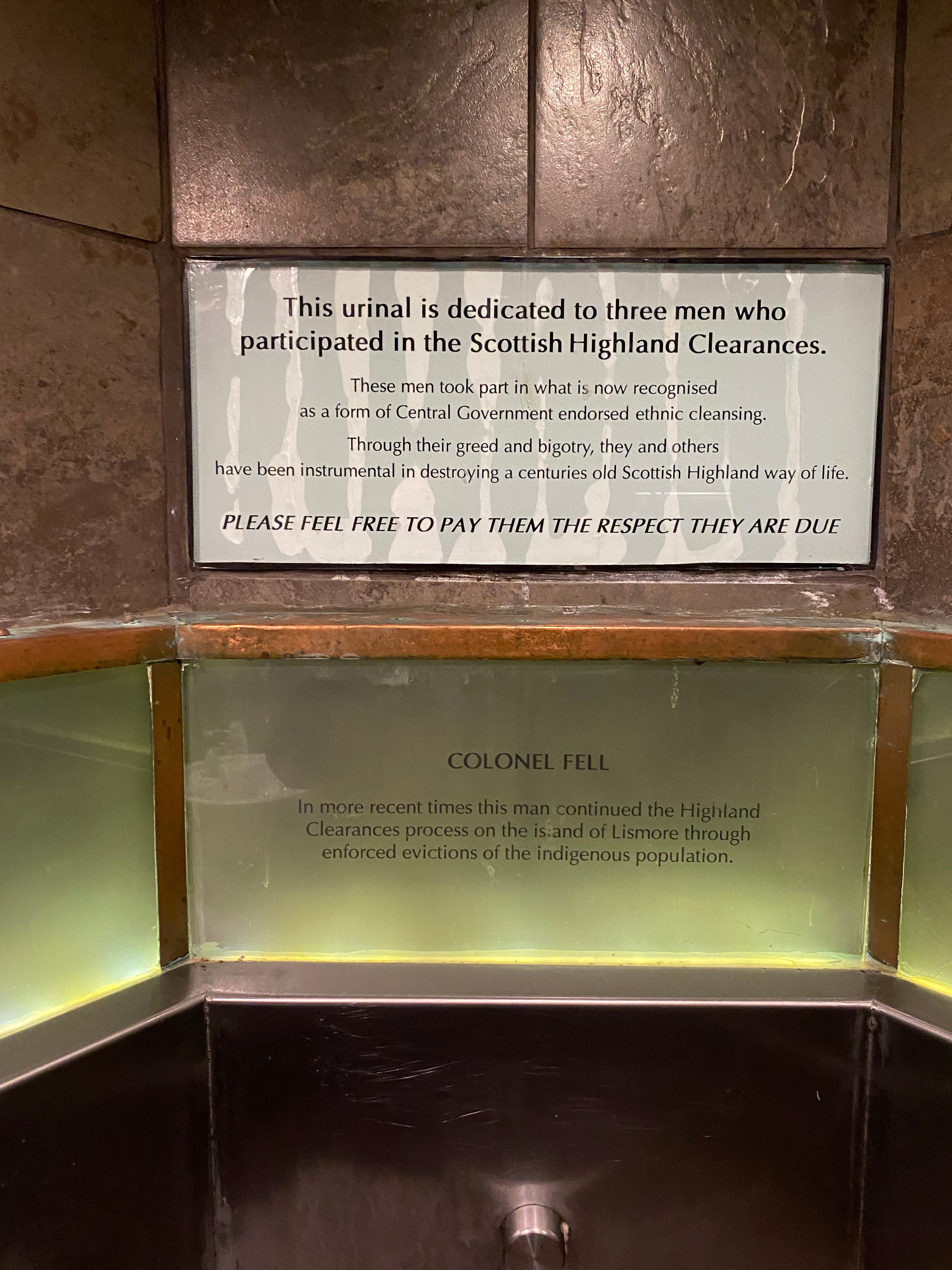
Otherwise, as the Danes like to say, the city ‘looks like itself’, albeit with more shuttered-up business premises than of yore. At Cowcaddens they have recently created cycle lanes that are wide enough to accommodate an articulated lorry. Precious few cycles occupied the lanes as yet; maybe Cowcaddens bike-riders need a week or two to believe their luck and spring into action. As my luck would have it I ended up drinking in some fine Partick hostelries, The Three Judges and the Lismore on Dumbarton Road, both of which would have been well outside my stomping grounds in the day. Nobody aimed a blow at me. Incidentally the gents toilets at the Lismore has a feature of particular interest to those with a love of Scottish history and class culture (see below) . I’ve not shown all of the three urinals, but it’s rather pleasing to be able to choose which particular scoundrel you wish to honour.
While in the West End we went to the excellent music and theatre venue Oran Mor to catch ‘A Play, A Pie and A Pint’, a great concept which does exactly what it says on the poster. As my dear old friend Catherine who lives in the incongruously named Glasgow neighbourhood of Mount Florida, later pointed out, the only problem with the whole thing is the effort involved in trying to sit in a theatre chair while balancing a pint with one hand, and eating a pie on a plate with the other, desperately trying to avoid getting brown sauce all over your hands and consequently stinking like a full Scottish breakfast for the rest of the day. I saw The Corinthian , a neat little monologue performed by Dayton Mungai which tells the fascinating story of Andy Watson, the first black footballer to play for, and indeed captain, the Scotland team in 1881 to a 6-1 victory over England while apparently also inventing the novel concept of passing the ball to other players at the venerable club of Queens Park whose ground became the Scottish national stadium Hampden Park in (apropos) Mount Florida. I kind of already knew about that last part from Dundee songwriter Michael Marra’s exquisite little vignette ‘The Wise Old men of Mount Florida’. The theatre piece was a timely reminder of the role that the currently much-disparaged community of ‘migrants’ have always played in a culture which you might be led to believe is in some way historically and generically exclusively ‘white’. It was also stirring to witness the passion with which the audience whooped, hollered and applauded at the curtain call, and one was left, albeit fleetingly, with the feeling that all is maybe not lost after all.
A Bit Misshapen
On the Sunday we took a trip to the legendary Glasgow flea-market known as ‘The Barras’, ostensibly to stock up on some of the best, liver-dissolvingly sugar-potent Scottish sweets for which I have a deep love, and which I can’t get in Denmark. Glickmans Sweet Shop is on Gallowgate and has rows and rows of jars containing the boilings, macaroon bars, tablet and Parma Violets of my childhood, all served by a very sweet lady stationed behind an imposing barrier of glass which makes you feel like you’re visiting a gun-supplier in Detroit. The stuff on these shelves is surely the crack cocaine of sugar addiction and it’s clear that there are some desperate people in this town. The little shop had everything I needed including a bag of butternuts, chewy dragees of a lurid hue rather worryingly described as ‘vibrant orange’ on the website. As I was about to pay, the woman behind the counter added, ‘That should be ten pounds thirty for everything, but d’you know what I’ll give you them for a tenner. Those butternuts are a bit misshapen. The man who has the factory is on holiday and he left someone else in charge who couldn’t work the machines properly.’
I do love Glasgow sometimes…
Great memories Pete and fascinating to learn about the hands off procedures, done remotely. Very remotely. Amazing! So glad you’re through it and healthy now.
PS It’s a long time since I’ve heard ‘I should co co’. Thanks! 😁